Society – Haiti
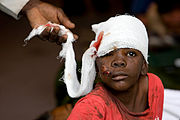
As I consider the natural disaster in Haiti this month, several things come to mind. Most of the e-mails I have received focus on the desperation of the people without any means of helping or supporting themselves, the terrible loss of life (and miraculous rescues) and the huge response of the global community in sending food and help. There have also been reports of people arriving with nothing in their hands, expecting to help but becoming a burden to others because of their own need for food, water and shelter. Fewer e-mails speak of Haitians waiting quietly and patiently in a long line at a newly opened community water source, or large groups of homeless singing together from dusk to midnight to pass the hours of darkness.
The questions I’ve been asking are: If I have nothing in the world, what do I really need? And what are the steps to rebuilding a society with millions of people and no means of auto-sufficiency? Haiti has a population where the average person makes less than $3 per day and only 50% can read. To add to the difficulty of their current situation, about 300,000 orphans are now dependent upon what their society can provide until they are able to make their own living.
And the result? It’s obvious that it will take between 3 and 6 years to restore what was their GNP, replace all the schools, homes and public buildings, and recreate a healthy and “normal” environment for Haitians in the Port-au-Prince area. But is that enough? I am not in favor of industrialization which creates new “needs” or dependencies, but there are basic societal improvements which lead to real positive development and an atmosphere of peace, security and confidence. Haiti is on record as one of the 2 poorest countries in the world. There are several causes for that but the primary ones are poor (and overpriced) education and a corrupt government that robs the people they are supposed to care for. Public education is mostly done in French, the official language, but 98% of the population speaks Creole every day. Can you imagine an educational career in a different language? The government initiated that travesty because the French had controlled Haiti from 1664 – 1804 and the language of the elite ruling class was French. Over the last 50 years 3 people have primarily controlled the country either as oppressive dictators or as greedy and embezzling presidents.
So one of the primary concerns for the establishment of a productive and peaceful society in Haiti is education. Not an education in French, not an education in modernism and liberalism with its accompanying dependence upon government, but a real and integrated education in Truth and in the God given rights and responsibilities of the individual and the family. With thousands of orphans and many more single parent families, the children and youth of Haiti need to know their individual value, their potential for life and learning, and their responsibility to be the future of their country, people with values and commitments and respect for others. They need to know how to read and write and use the resources of their beautiful country for the good of their community. Most of all they need to know how much their Creator loves them and about His unique purpose for each of them. So with millions of dollars pouring into Haiti, who is going to really do something of lasting value, something that will do more than just provide a few meals and some medicine? The great thing is that people are doing something! Anything, just to keep people alive, is far better than nothing at all but there is a long road ahead for the people of Haiti to have real hope for their future.